
Overview: The Standard for 100G Networking
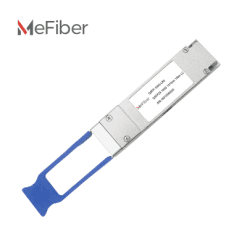
The 100G QSFP28 (Quad Small Form-factor Pluggable 28) is the industry’s dominant optical transceiver form factor for 100 Gigabit Ethernet applications. Its name, QSFP28, signifies its capability: “QSFP” for its physical size, identical to the 40G QSFP+, and “28” indicating its electrical interface of 4 lanes, each running at up to 28Gbps. This compact, hot-pluggable module has become the universal choice for deploying 100G connectivity in data centers, enterprise core networks, and high-performance computing environments due to its exceptional port density, low power consumption, and cost-effectiveness.
By delivering 100Gbps in a compact package, the QSFP28 form factor allows network operators to dramatically increase bandwidth without the need for a larger physical footprint, making it a cornerstone of modern network architecture.
Choosing the Right 100G QSFP28 Module
Selecting the correct 100G QSFP28 module depends entirely on your specific requirements for transmission distance, fiber optic cable type, and budget. Below is a guide to the most common types available.
100GBASE-SR4 QSFP28
The workhorse for short-reach data center connections. It uses 8 strands of multi-mode fiber (MMF) via an MPO/MTP connector to transmit data up to 70 meters on OM3 MMF or 100 meters on OM4 MMF. It is ideal for Top-of-Rack (ToR) to spine connections within the same data hall.
100GBASE-LR4 QSFP28
The standard for long-reach connectivity over single-mode fiber (SMF). It uses WDM technology to multiplex four 25Gbps signals onto a pair of fibers via a Duplex LC connector, enabling transmission distances of up to 10 kilometers. Perfect for connecting buildings across a campus or data centers in a metro area.
100GBASE-ER4 QSFP28
For extended long-reach applications, the ER4 variant supports distances up to 40 kilometers over SMF with a Duplex LC connector. It incorporates a semiconductor optical amplifier (SOA) to boost the signal, making it suitable for metro and regional network links.
100G CWDM4 QSFP28
A highly cost-effective alternative to LR4 for intermediate reaches. The CWDM4 module supports distances up to 2 kilometers over duplex SMF with an LC connector. It is a popular choice for large data center interconnects where LR4’s 10km reach is unnecessary and overly expensive.
100G BiDi QSFP28
A revolutionary module for infrastructure upgrades. The BiDi (Bi-Directional) transceiver allows you to achieve 100G speeds over your existing duplex multi-mode fiber cabling using standard LC connectors. This eliminates the need for a costly MPO fiber plant upgrade when moving from 10G/40G, saving significant time and money.
Comparison of Common 100G QSFP28 Types
| Module Type | Fiber Type | Connector | Max Reach | Key Application |
|---|---|---|---|---|
| 100GBASE-SR4 | MMF (OM4) | MPO-12 | 100 meters | Short-reach data center |
| 100G BiDi | MMF (OM4) | Duplex LC | 100 meters | Upgrading 10G MMF to 100G |
| 100G CWDM4 | SMF | Duplex LC | 2 kilometers | Cost-effective DCI |
| 100GBASE-LR4 | SMF | Duplex LC | 10 kilometers | Campus & Metro links |
| 100GBASE-ER4 | SMF | Duplex LC | 40 kilometers | Long-haul & Telecom |
FAQ
1. What is the difference between QSFP+ and QSFP28?
While they share the same physical form factor, QSFP+ is designed for 40G Ethernet (4x10G lanes) and QSFP28 is designed for 100G Ethernet (4x25G lanes). A QSFP28 port can typically accept a QSFP+ module, but not vice versa.
2. Can I use a QSFP28 module in a 40G QSFP+ port?
No. The port’s electronics are designed for 4x10G lanes and cannot support the 4x25G electrical interface of a QSFP28 module.
3. What is 100G Breakout Mode?
Breakout mode allows a 100G QSFP28 port to be split into four independent 25G SFP28 interfaces. This is commonly done using a 100GBASE-SR4 module with an MPO-to-4xLC breakout cable, connecting a single 100G switch port to four 25G server ports.
4. How do I choose the right 100G QSFP28 module?
Start with two questions: 1) What is your fiber type (multi-mode or single-mode)? 2) What is the link distance? For MMF under 100m, choose SR4 (new cabling) or BiDi (existing cabling). For SMF, choose CWDM4 (up to 2km), LR4 (up to 10km), or ER4 (up to 40km).
5. Are your QSFP28 modules compatible with brands like Cisco and Arista?
Yes, our transceivers are built to be fully compliant with Multi-Source Agreements (MSAs). This ensures they function identically to modules from original equipment manufacturers and are compatible with the vast majority of networking platforms that follow these open standards.