
Overview
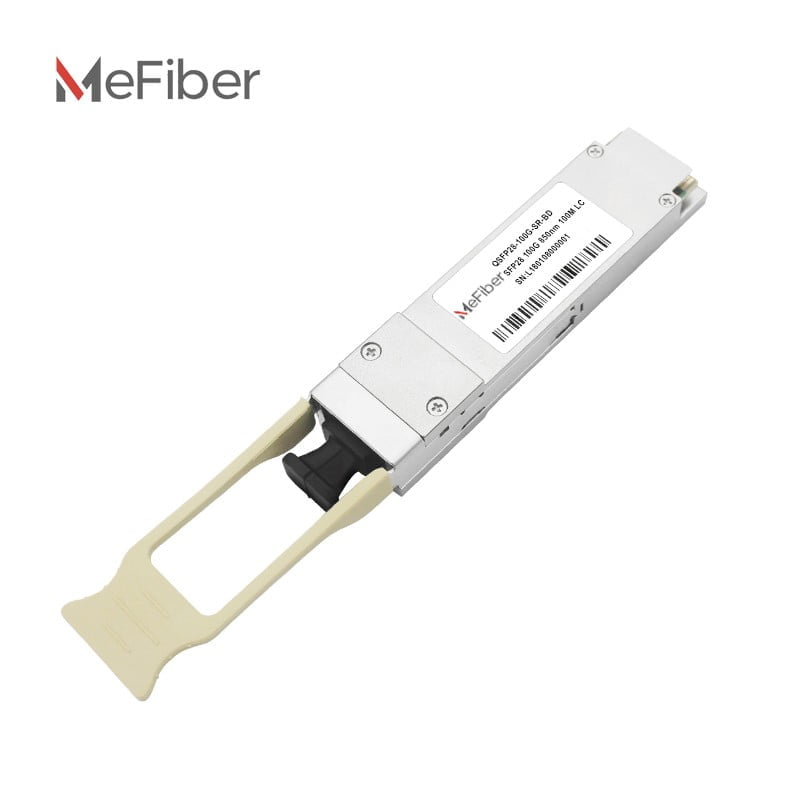
This module is a high-performance, cost-effective optical transceiver designed as a fully compatible equivalent to the Cisco QSFP28 BiDi 100G module. It represents a breakthrough solution for data centers and enterprises looking to upgrade their networks from 10GbE or 40GbE to 100GbE without undertaking a costly and disruptive overhaul of their existing fiber optic cabling infrastructure.
The key innovation of this 100G BiDi (Bi-Directional) technology is its ability to transmit and receive 100Gbps over a standard Duplex LC connector on multi-mode fiber. Unlike traditional 100G SR4 modules that require 8-fiber MPO connectors, this transceiver uses two different wavelengths (e.g., 850nm and 900nm) on each fiber strand to carry 50Gbps in each direction. This allows it to operate over the same two-fiber MMF cabling that is widely deployed for 10G-SR and 40G-BiDi networks, providing a seamless and economical upgrade path to 100G speeds.
Key Features
- 100% compatible with Cisco platforms that support the QSFP28 100G BiDi module.
- Standard: Follows the 100GBASE-SR BiDi MSA specifications.
- Direct Upgrade Path: Enables 100G connectivity over existing 10G/40G Duplex LC MMF cabling.
- Data Rate: 103.1 Gbps aggregate.
- Connector: Standard Duplex LC/UPC.
- Reach:
- Up to 70m on OM3 Multi-Mode Fiber.
- Up to 100m on OM4 Multi-Mode Fiber.
- Up to 150m on OM5 Multi-Mode Fiber.
- Wavelengths: Bi-Directional transmission using 850nm and 900nm wavelength windows.
- Built-in Digital Optical Monitoring (DOM/DDM) for real-time diagnostics.
- Hot-pluggable QSFP28 form factor.
Applications
The QSFP28 100G BiDi compatible module is purpose-built for:
- Cost-effective data center upgrades from 10G-SR/40G-SR4 to 100G.
- High-density 100G switch-to-switch and switch-to-server connections.
- Enterprise core and distribution layer interconnects.
- Any application requiring a 100G link where MPO cabling is not available or practical.
Specifications
| Parameter | Value |
|---|---|
| Compatible Part Number | QSFP28-100G-BIDI / QSFP-100G-SR-BIDI |
| Form Factor | QSFP28 |
| Standard | 100GBASE-SR BiDi |
| Data Rate | 103.1 Gbps |
| Wavelengths | 850nm / 900nm (Bi-Directional) |
| Max Distance | 100m (OM4) |
| Fiber Type | Multi-Mode Fiber (MMF) |
| Connector Type | Duplex LC/UPC |
| DOM/DDM Support | Yes |
| Operating Temperature | 0°C to 70°C (32°F to 158°F) |
Cross-Platform Compatibility
Programmed for seamless integration with Cisco equipment, this module’s adherence to multi-source agreement (MSA) standards ensures it can also be deployed in networking hardware from other major manufacturers that support this optical specification.
| MANUFACTURER | EQUIVALENT PART NUMBER |
|---|---|
| Arista | QSFP-100G-SRBD |
| Juniper | JNP-QSFP-100G-BIDI |
| Extreme | 10405 |
| MSA Generic | QSFP-100G-BIDI-SR |
FAQ (Technical & Product Questions)
1. How does 100G BiDi work over a Duplex LC connector?
Unlike a standard SR4 module which uses four parallel fibers to send 25G each, a 100G BiDi module uses Wavelength Division Multiplexing (WDM) over a single fiber pair. On each of the two fibers in the Duplex cable, it sends one wavelength (e.g., 850nm) and receives another (e.g., 900nm). Each wavelength carries a 50Gbps PAM4 signal. This allows for a full-duplex 100Gbps connection over the same two-fiber cable used for 10G.
2. What is the main advantage of 100G SR BiDi over standard 100G SR4?
The primary advantage is cost savings and simplicity. It allows you to reuse your existing Duplex LC multi-mode fiber cabling plant when upgrading from 10G to 100G. Standard 100G SR4 requires new, more complex, and more expensive 8-fiber MPO/MTP cabling. Using BiDi eliminates the need for this significant re-cabling effort.
3. Can a 100G SR BiDi module connect to a 100G SR4 module?
No, they are not interoperable. They use fundamentally different technologies, fiber counts, and physical connectors. A 100G SR BiDi module uses a Duplex LC connector, while a 100G SR4 module uses an MPO-12 connector. You must use a 100G SR BiDi module on both ends of the link.
4. What type of fiber patch cable is required for this module?
This module requires a standard multi-mode fiber (MMF) patch cable terminated with Duplex LC/UPC connectors. For best performance and to achieve the maximum reach, use OM4 grade fiber (for up to 100m) or OM5 grade fiber (for up to 150m). It is also backward compatible with OM3 fiber for shorter distances (up to 70m).
5. Does this module require Forward Error Correction (FEC)?
Yes. The 100G standard relies on the host device (switch, router, or NIC) to enable RS-FEC (Reed-Solomon Forward Error Correction) as defined in IEEE 802.3bm. FEC is essential for ensuring an error-free link at 100Gbps speeds.


Reviews
There are no reviews yet.