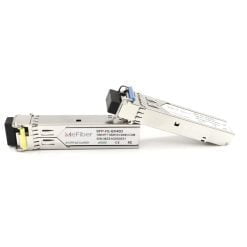

The 155M BiDi SFP transceiver modules enable cost‑efficient 155 Mb/s optical links using a single fiber strand.
Compliant with ITU‑T G.957, STM‑1 / OC‑3, and SFP MSA (SFF‑8074/8472) standards, these transceivers use bi‑directional wavelength division multiplexing to transmit and receive signals on two different wavelengths over one fiber.
Typical products operate at 1270 / 1330 nm or 1310 / 1550 nm pairs, offering reliable reach options from 10 km to 120 km SMF.

Technical Specifications

  • Data Rate: 155 Mb/s (OC‑3 / STM‑1 / 100BASE‑BX)
  • Wavelengths: Tx 1270 nm / Rx 1330 nm or Tx 1310 nm / Rx 1550 nm (BiDi pairs)
  • Transmission Distance: 10 km – 120 km over SMF
  • Connector Type: Simplex LC
  • Optical Components: FP Tx / PIN Rx (standard), APD Rx for long reach versions
  • Power Consumption: ≤ 1.0 W
  • DDM/DOM: Supported per SFF‑8472 (optional)
  • Compliance: ITU‑T G.957 · IEEE 802.3u · SFP MSA · RoHS 6

Main Features

  • Single‑fiber BiDi design reduces fiber usage by 50 %
  • Supports SONET OC‑3, SDH STM‑1, and 100BASE‑BX Fast Ethernet
  • Various reach options: 10 km, 20 km, 40 km, 80 km, and 120 km
  • Compact Hot‑pluggable SFP form factor for switches and multiplexers
  • Low power (≤ 1 W) and low EMI for dense environments
  • Advanced DOM provides real‑time optical link monitoring
  • Industrial temperature versions (‑40 °C to +85 °C) available
  • Interoperable with major vendors’ equipment (Cisco, Huawei, Juniper, etc.)

Applications

  • SDH STM‑1 and SONET OC‑3 transport systems
  • 100BASE‑BX Fast Ethernet single‑fiber media converters
  • Access and metro edge networks
  • Industrial and CCTV applications with single‑fiber infrastructure
  • FTTH and legacy telecom last‑mile deployments

Related Keywords: 155M BiDi SFP, OC‑3 BiDi SFP, STM‑1 BiDi SFP module, 100BASE‑BX SFP, Single‑Fiber SFP 155 Mb/s, MEFiber BiDi SFP 155M.

FAQ – 155M BiDi SFP Modules

1. What is a 155M BiDi SFP transceiver?

A 155M BiDi SFP is a 155 Mb/s optical module that uses two different wavelengths to send and receive signals over a single fiber strand.

2. How does a BiDi SFP differ from a standard duplex SFP?

A BiDi SFP uses a simplex LC connector and transmits/receives on separate wavelengths (Tx/Rx 1270 / 1330 nm), whereas a duplex SFP requires two fibers.

3. What standards does the 155M BiDi SFP conform to?

It meets ITU‑T G.957 for SDH STM‑1 and SONET OC‑3 as well as IEEE 802.3u for 100BASE‑BX Fast Ethernet.

4. What are the typical reach options for 155M BiDi SFP?

Short‑haul (10–20 km), mid‑range (40 km), and long‑haul versions (80–120 km) are available depending on wavelength and optical budget.

5. Can a 155M BiDi SFP be used in Gigabit ports?

No, it must be used in ports designed for 155 Mb/s operation (OC‑3/STM‑1 compatible interfaces).

6. Does it support DDM/DOM optical monitoring?

Yes, many MEFiber 155M BiDi SFPs include SFF‑8472 digital diagnostics for real‑time link monitoring and predictive maintenance.

7. Are industrial temperature versions available?

Yes, industrial (‑40 → +85 °C) options ensure reliable performance in outdoor and factory environments.

8. What are common use cases for 155M BiDi SFP modules?

They are ideal for metro edge, access, FTTx, and industrial Ethernet deployments requiring single‑fiber connectivity.

This website uses cookies to ensure you get the best experience on our website.