
Overview
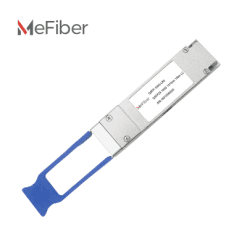
This module is a high-performance optical transceiver engineered as a fully compatible and cost-effective equivalent to the Cisco QSFP-100G-LR-S. It is designed to the 100GBASE-LR single-lambda specification, representing a significant advancement over the older, four-lane 100GBASE-LR4 standard. By using a single wavelength with PAM4 (Pulse Amplitude Modulation 4-level) signaling, this transceiver can transmit the full 100 Gbps data stream over a standard pair of single-mode fibers.
This single-lambda architecture simplifies the transceiver design, reduces power consumption, and lowers overall cost. It is an ideal solution for point-to-point 100 Gigabit Ethernet links up to 10 kilometers, perfect for campus and enterprise core networks, data center interconnects (DCI), and service provider applications requiring a streamlined, high-density 100G interface.
Key Features
- 100% compatible with Cisco platforms that support the QSFP-100G-LR-S module.
- Standard: Compliant with 100GBASE-LR (Single Lambda) and QSFP28 MSA.
- Advanced Technology: Utilizes a single 100G PAM4 optical lane for greater efficiency and lower cost.
- Data Rate: 106.25 Gbps (53.125 Gbaud/s PAM4).
- Connector: Standard Duplex LC/UPC.
- Reach: Supports link lengths up to 10km on SMF (OS2).
- Wavelength: 1310nm EML laser.
- Built-in Digital Optical Monitoring (DOM/DDM) for real-time diagnostics.
- Hot-pluggable QSFP28 form factor.
Applications
The QSFP-100G-LR-S compatible module is the perfect choice for:
- Point-to-point 100G connectivity in enterprise and campus backbones.
- Medium-reach Data Center Interconnects (DCI).
- High-speed connections between core routers and aggregation switches.
- Service provider networking and metro access links.
Specifications
| Parameter | Value |
|---|---|
| Compatible Part Number | QSFP-100G-LR-S |
| Form Factor | QSFP28 |
| Standard | 100GBASE-LR (Single Lambda) |
| Data Rate | 106.25 Gbps |
| Wavelength | 1310nm |
| Max Distance | 10km |
| Fiber Type | Single-Mode Fiber (SMF) |
| Connector Type | Duplex LC/UPC |
| DOM/DDM Support | Yes |
| Operating Temperature | 0°C to 70°C (32°F to 158°F) |
Cross-Platform Compatibility
Programmed for seamless integration with Cisco equipment, this module’s adherence to 100GBASE-LR MSA standards ensures it can also be deployed in networking hardware from other major manufacturers that support this optical specification.
| MANUFACTURER | EQUIVALENT PART NUMBER |
|---|---|
| Arista | QSFP-100G-LR |
| Juniper | JNP-QSFP-100G-LR |
| Extreme | 100G-QSFP28-LR-10KM |
| MSA Generic | QSFP-100G-LR |
FAQ (Technical & Product Questions)
1. What is the difference between this 100GBASE-LR module and 100GBASE-LR4?
This 100GBASE-LR module is based on newer “single lambda” technology, which uses one optical lane of 100G PAM4 signaling. The older 100GBASE-LR4 standard uses four separate 25G optical lanes on four different wavelengths (LAN-WDM), which are multiplexed together. The single-lambda approach is more power-efficient, less complex, and more cost-effective.
2. Are 100GBASE-LR (Single Lambda) and 100GBASE-LR4 modules interoperable?
No, they are not interoperable. Despite both being “LR” (Long Reach) standards for 10km, their underlying technologies are completely different. A single-lambda module cannot establish a link with a four-lane LR4 module. You must use the same type of module on both ends of the fiber link.
3. Can I use this module for 4x25G breakout applications?
No. As a single-lambda module, it operates as a single, indivisible 100G channel. It cannot be split, or “broken out,” into multiple lower-speed links. For breakout over single-mode fiber, you would need a parallel optics module like the QSFP-100G-PSM4 or QSFP-100G-PLR4L.
4. What does the “-S” suffix mean in the Cisco part number QSFP-100G-LR-S?
In Cisco’s naming convention, the “-S” suffix typically designates an “S-Class” part. S-Class optics are optimized for standard enterprise and data center operating temperatures and environments, often providing a more cost-effective solution compared to non-S-Class modules that are built for more demanding service provider temperature ranges and applications.
5. What kind of fiber patch cable is required for this module?
This module requires a standard single-mode fiber (SMF) patch cable (OS2 grade is recommended) terminated with Duplex LC/UPC connectors. This is one of the most common types of fiber cabling used in data centers and enterprise networks.


Reviews
There are no reviews yet.