
Overview
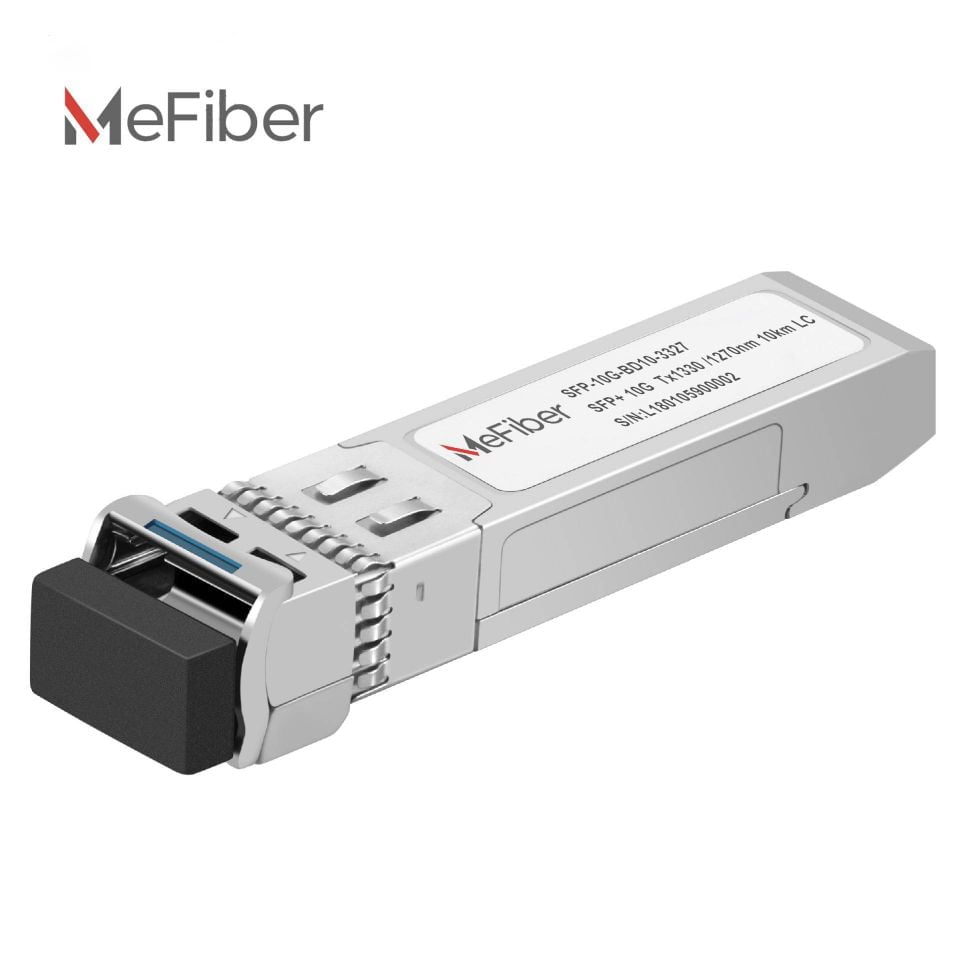
This module is a high-performance, industrial-grade Bi-Directional (BiDi) optical transceiver designed as a fully compatible alternative to the Cisco SFP-10G-BXD-I. It is engineered to operate over a single strand of standard single-mode fiber, doubling the capacity of existing fiber infrastructure and significantly reducing cabling costs. This is achieved by using Wavelength Division Multiplexing (WDM) to transmit and receive signals on two different wavelengths simultaneously.
Specifically, this is the “Downstream” (D) module, transmitting at 1330nm and receiving at 1270nm. It must be paired with an “Upstream” (U) module (like the SFP-10G-BXU-I) at the opposite end of the link. The “-I” designation signifies that it is built for industrial applications, capable of operating reliably in an extended temperature range of -40°C to 85°C (-40°F to 185°F), making it perfect for outdoor deployments, factory floors, and other unconditioned environments.
Key Features
- 100% compatible with Cisco platforms that support the SFP-10G-BXD-I module.
- Standard: Compliant with 10GBASE-BX10-D and SFP+ MSA.
- Industrial Grade: Supports an extended operating temperature range of -40°C to 85°C.
- Single-Fiber Operation: Transmits and receives on a single fiber strand, saving on cabling costs.
- Data Rate: 10.3125 Gbps.
- Connector: Simplex LC/UPC.
- Reach: Supports link lengths up to 10km on SMF (OS2).
- Wavelengths: TX 1330nm / RX 1270nm.
- Built-in Digital Optical Monitoring (DOM/DDM) for real-time diagnostics.
- Hot-pluggable SFP+ form factor.
Applications
The rugged, SFP-10G-BXD-I compatible module is ideal for:
- Industrial Ethernet networks and factory automation.
- Outdoor deployments such as intelligent transportation systems (ITS) and smart city infrastructure.
- Harsh environment telecommunications and Wireless/5G backhaul.
- Fiber-to-the-home (FTTH) and enterprise network upgrades where fiber is limited.
Specifications
| Parameter | Value |
|---|---|
| Compatible Part Number | SFP-10G-BXD-I |
| Form Factor | SFP+ |
| Standard | 10GBASE-BX10-D |
| Data Rate | 10.3125 Gbps |
| TX Wavelength | 1330nm |
| RX Wavelength | 1270nm |
| Max Distance | 10km |
| Fiber Type | Single-Mode Fiber (SMF) |
| Connector Type | Simplex LC/UPC |
| DOM/DDM Support | Yes |
| Operating Temperature | -40°C to 85°C (-40°F to 185°F) |
Cross-Platform Compatibility
Programmed for seamless integration with Cisco equipment, this module’s adherence to 10GBASE-BX10-D MSA standards ensures it can also be deployed in industrial networking hardware from other major manufacturers that support this optical specification. Note: This is a downstream module and must be paired with an upstream (e.g., SFP-10G-BXU-I) module at the other end.
| MANUFACTURER | EQUIVALENT PART NUMBER |
|---|---|
| Juniper | SFPP-10G-BXD-I |
| Extreme | 10GB-BXD-10-I |
| Arista | SFP-10G-BXD10-I (verify compatibility) |
| MSA Generic | SFP-10G-BX-D-I |
FAQ (Technical & Product Questions)
1. What is a BiDi transceiver and how does it work?
A Bi-Directional (BiDi) transceiver transmits and receives optical signals over a single fiber strand. It uses an internal WDM (Wavelength Division Multiplexing) coupler that splits two different wavelengths of light. One wavelength is used for transmitting (TX) and the other for receiving (RX), allowing full-duplex communication on one fiber instead of the usual two.
2. What does the “D” in SFP-10G-BXD-I mean?
The “D” stands for “Downstream”. In a BiDi pair, one module is designated Upstream (U) and the other Downstream (D). This module (D) transmits at 1330nm and receives at 1270nm. It MUST be connected to an Upstream module (e.g., SFP-10G-BXU-I) on the other end, which has the opposite configuration (transmits at 1270nm, receives at 1330nm). The pair will not work otherwise.
3. What is the main advantage of using BiDi optics?
The primary advantage is fiber conservation. By operating on a single fiber, BiDi transceivers effectively double the capacity of an existing fiber plant. This is extremely valuable in scenarios where laying new fiber is expensive or impossible, allowing for network upgrades without additional cabling.
4. What does “Industrial” or “-I” signify for this module?
The “Industrial” or “-I” suffix indicates that the module is designed and tested to operate reliably in an extended temperature range, typically from -40°C to 85°C (-40°F to 185°F). This makes it suitable for deployment in non-climate-controlled environments like outdoor enclosures, factory floors, and transportation infrastructure where commercial-grade (0°C to 70°C) modules would fail.
5. What kind of fiber patch cable is required for this module?
This module requires a single-mode fiber (SMF) patch cable (OS2 grade is recommended) terminated with Simplex LC/UPC connectors. A duplex cable can also be used, but only one of the two strands will be connected and utilized.


Reviews
There are no reviews yet.