
Overview
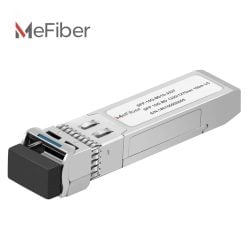
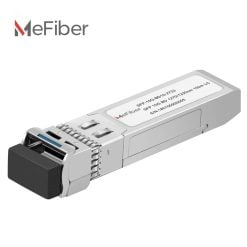
This is the upstream component of a high-performance SFP+ 10G BiDi 100km transceiver pair, specifically engineered for ultra-long-reach network connections. It is fully compatible with Cisco SFP-10G-BX100U specifications, offering a robust and cost-effective solution for service providers and enterprises. When paired with its downstream counterpart (SFP-10G-BX100D), this module enables 10Gbps bidirectional communication over a single strand of fiber.
By leveraging Bi-Directional (BiDi) WDM technology, this optical transceiver dramatically reduces fiber cabling costs. In practice, this is ideal for long-haul links where deploying new fiber is prohibitively expensive. Consequently, it provides a smart, efficient path for network expansion or upgrades over existing single-fiber infrastructure.
Key Features
- Ultra Long-Haul Reach: Delivers reliable 10Gbps data transmission up to an impressive distance of 100km.
- Single Fiber Operation: Utilizes WDM technology with a 1490nm-TX/1550nm-RX wavelength pair to transmit and receive on one fiber.
- Guaranteed Compatibility: Functions as a seamless, plug-and-play replacement for the SFP-10G-BX100U module.
- Reduced Infrastructure Cost: The single fiber design immediately halves fiber cabling requirements, saving significant capital expenditure.
- Hot-Pluggable SFP+ Design: Allows for insertion or removal from network devices without causing service interruption.
- Digital Optical Monitoring (DOM): Enables real-time monitoring of critical parameters like optical power, temperature, and voltage for network health.
Applications
This versatile 10GBASE-BX100-U SFP+ module is field-proven for establishing stable, long-distance links where fiber resources are limited. It is the go-to choice for service providers and large-scale networks. For this reason, it is frequently deployed in:
- ISP and Telecom Long-Haul Networks
- Metro Ethernet and Regional Network Connections
- Data Center Interconnects (DCI) over long distances
- Mobile Backhaul and Fronthaul (5G/LTE) Links
- Fiber-to-the-Home (FTTH) and Business (FTTB) Deployments
Specifications
| Parameter | Value |
|---|---|
| Compatibility | Cisco SFP-10G-BX100U |
| Form Factor | SFP+ |
| Max Data Rate | 10.3125 Gbps |
| Wavelength | TX: 1490nm / RX: 1550nm |
| Max Cable Distance | 100km |
| Connector | Simplex LC/UPC |
| Fiber Type | Single-Mode Fiber (SMF) |
| Transmitter Type | DFB |
| Receiver Type | APD |
| DOM Support | Yes |
| Commercial Temperature Range | 0 to 70°C (32 to 158°F) |
| Protocols | MSA Compliant, IEEE 802.3ae |
Advantages
Choosing this single fiber 10G transceiver delivers significant operational and financial benefits. Each module is rigorously tested for interoperability, ensuring it integrates flawlessly with original manufacturer equipment and other MSA-compliant hardware. This provides unmatched flexibility and protects your investment by avoiding vendor lock-in.
Moreover, the long-term reliability of this 100km BiDi SFP+ ensures stable performance, reducing network downtime and maintenance costs. Its plug-and-play functionality simplifies deployment, allowing network engineers to quickly establish ultra-long-reach links with confidence. In essence, it is the smartest way to maximize your existing fiber assets.
FAQ (Technical & Product Questions)
1. What is an ‘upstream’ BiDi transceiver?
An upstream BiDi transceiver, denoted by the ‘U’ in a model like SFP-10G-BX100U, is one half of a matched pair. It transmits on the lower wavelength (1490nm in this case) and receives the higher wavelength (1550nm) from its ‘downstream’ partner module at the other end of the fiber.
2. Do I need to buy this SFP-10G-BX100U module with a specific partner?
Yes, absolutely. BiDi technology requires a matched pair for a link to function. This 10GBASE-BX100-U SFP+ must be connected to a downstream SFP-10G-BX100D module at the far end of the single fiber strand.
3. What is the difference between SFP-10G-BX100U and SFP-10G-BX100D?
The only difference is the transmit (TX) and receive (RX) wavelengths, which are reversed. The ‘U’ module transmits at 1490nm and receives at 1550nm, while the ‘D’ module transmits at 1550nm and receives at 1490nm. This allows them to communicate over a single fiber.
4. Can I use this module for a link shorter than 100km?
Yes, but it is not recommended for very short links without proper testing. The laser in a 100km BiDi SFP+ is very powerful and can overwhelm the receiver on a short run, causing errors. An optical attenuator may be required to reduce the signal strength for shorter distances.
5. What does 1490nm-TX/1550nm-RX mean?
This specification defines the wavelengths used by this specific BiDi module. The 1490nm-TX means this transceiver transmits (TX) a 1490nm light signal, and the 1550nm-RX means it receives (RX) a 1550nm signal from its downstream partner module.
6. Is this module compatible with all OEM equipment?
This module is coded to be compatible with any networking device that accepts the original SFP-10G-BX100U transceiver. It adheres to MSA standards for broad interoperability with other compliant hardware as well.
7. What kind of fiber patch cord is required for this module?
You need a standard single-mode fiber (SMF) patch cord. Because this is a single fiber 10G transceiver, the cable must be terminated with Simplex LC connectors, as it only uses one fiber core for both sending and receiving data.
8. Does this module support Digital Optical Monitoring (DOM)?
Yes, it fully supports DOM (also known as DDM). This crucial feature provides network administrators with real-time diagnostic data from the SFP+ 10G BiDi 100km transceiver, including TX/RX power, temperature, and voltage, which helps in troubleshooting and maintaining link stability.


Reviews
There are no reviews yet.